


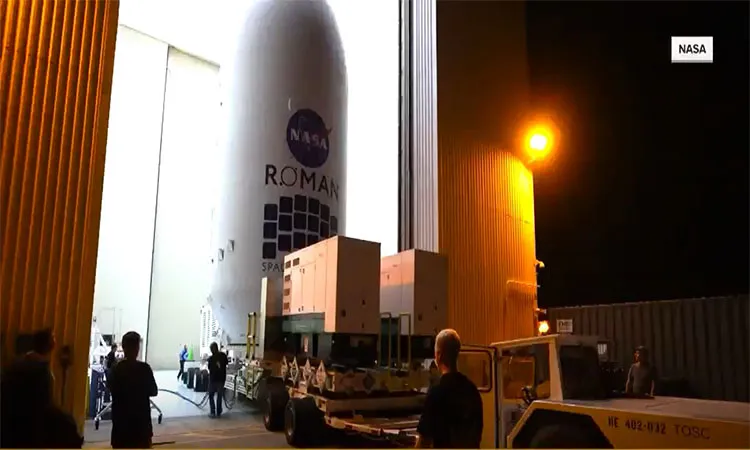
NASA is set to launch its next-generation space telescope on Sunday, aiming to survey hundreds of millions of stars and billions of galaxies in search of clues about dark energy and dark matter.
The Nancy Grace Roman Space Telescope will lift off at 7:26 a.m. ET from NASA's Kennedy Space Center in Florida with riding atop a SpaceX Falcon Heavy rocket. NASA will stream the launch live starting at 6:20 a.m. ET.
Often compared to the Hubble Space Telescope, Roman is expected to transform our understanding of the universe. Over its five-year mission it will scan more sky than any previous space telescope, explore unmapped regions of the Milky Way and discover over 100,000 planets beyond our solar system.

"Some of our longest-standing mysteries in modern astrophysics are: what is the nature of dark matter and dark energy?" said astrophysicist Neil deGrasse Tyson. "This telescope is going to try to give us the best data available."
The $4.3 billion mission the developed over nearly two decades is launching nine months ahead of schedule despite pandemic-related delays and government shutdowns.

After launch the Roman will travel over three months to reach L2 a stable point in space about 1 million miles from Earth, joining the James Webb Space Telescope there.
Roman can scan the sky 1,000 times faster than Hubble, capturing images at least 100 times larger. Its surveys will map the Milky Way's dense core and probe dark matter and dark energy.
The telescope honors Nancy Grace Roman the NASA's first astronomy chief who helped secure funding for Hubble before her death in 2018.

