


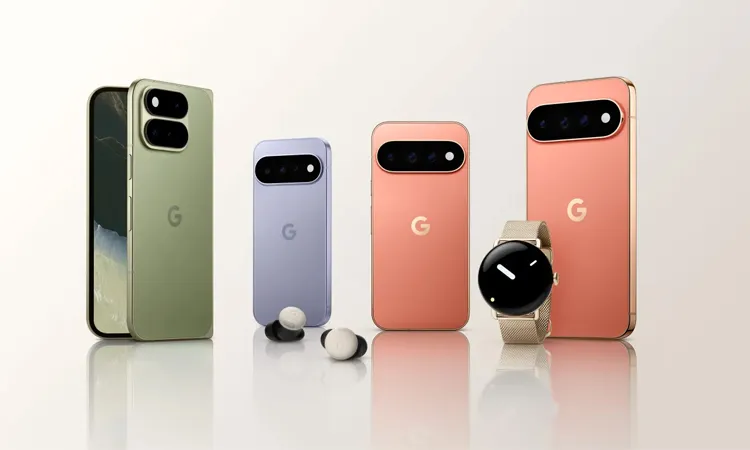
Google has unveiled its latest Pixel phone lineup with featuring slimmer cameras with stronger zoom capabilities and expanded AI tools designed to simplify everyday tasks.
The upgrades aim to encourage upgrades and grow the user base for Google's AI tools. Forrester senior analyst Andrew Cornwall said Google continues to position new AI-driven software with such as extracting photos from videos also a built-in teleprompter with improved video stabilization and better speech-to-text as the main reason to buy.

While Pixel phones remain less popular than the iPhone, Google has steadily expanded AI integration since 2023. Apple by contrast has lagged behind and announcing new AI features in June that rely partly on Google's Gemini model with an emphasis on privacy.
The new phones double previous storage, starting at 256GB, offer 30 hours of battery life and faster wireless charging. Google has discontinued the 128GB Pixel 11, previously its cheapest option at $800.
Starting Wednesday, U.S. customers can order the Pixel 11, Pixel 11 Pro and Pixel 11 Pro XL priced from $900, $1,100 and $1,300 respectively while the Pixel Pro Fold starts at $1,900 a $100 increase across the board from last year.
New features include live translation for videos, podcasts and voice messages. The Pro models introduce HiLight, which lights up the phone in a chosen color for specific callers when placed face down with complementing the existing "Flip to Shhh" silent mode. Buyers of the Pro or Pro XL models also get a free six-month AI Pro subscription as Google pushes its Gemini AI tools to compete with ChatGPT.
Camera upgrades include Magic Capture which captures a burst of photos and video with one tap along with improved low-light performance. Google also launched its first tracking device, Pixel Tag, priced at $30 individually or $100 for a four-pack.

