


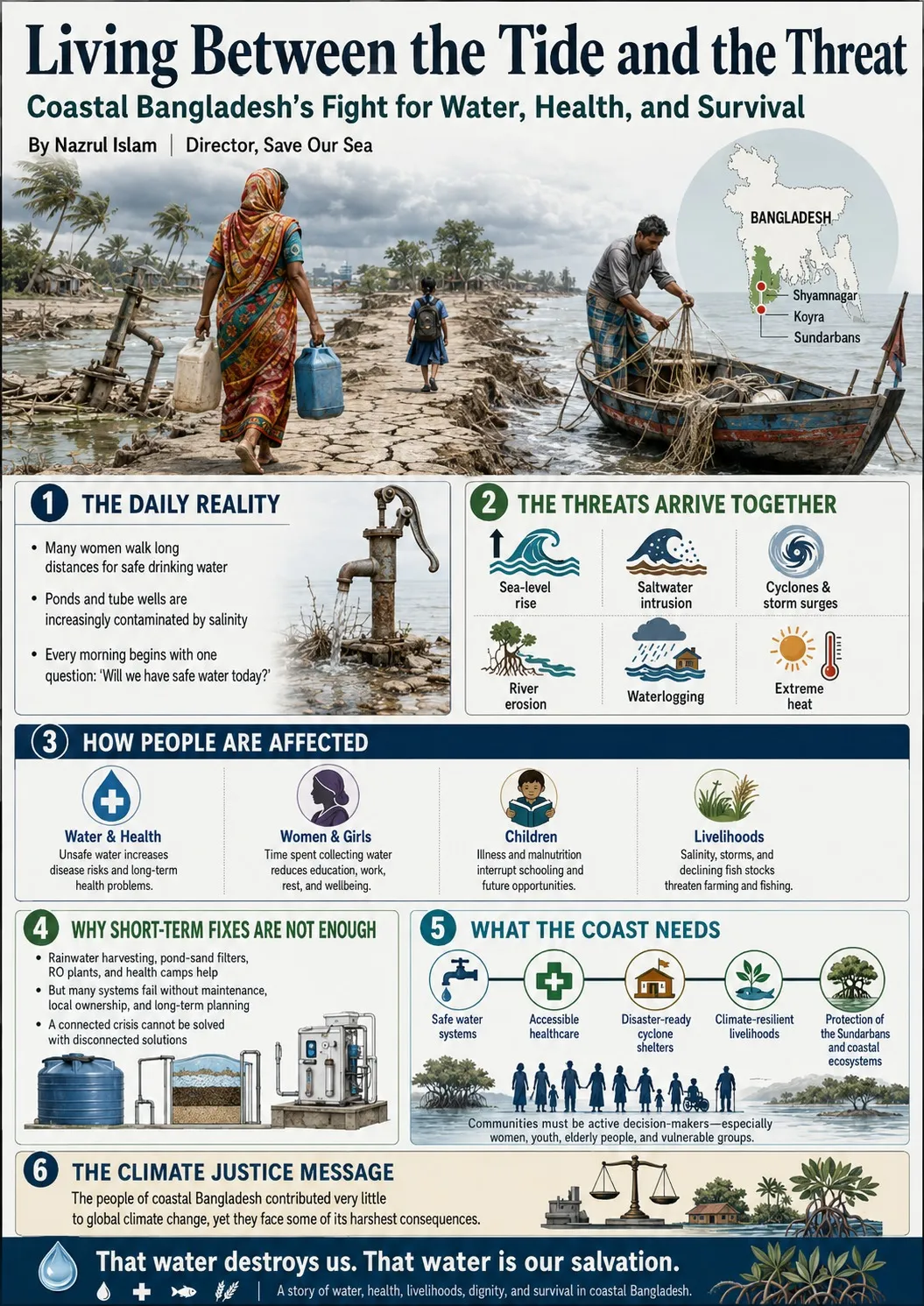
As the first light of dawn breaks over the remote villages of Shyamnagar and Koyra in southwestern Bangladesh, thousands of coastal families begin a day defined by a painfully familiar ritual. Before preparing breakfast, before heading to work, or sending children to school, women step out of their homes clutching empty plastic containers. Their destination is not a market or a workplace, but a distant water source in a desperate search for something increasingly scarce: safe drinking water.
They navigate fragile embankments scarred by successive cyclones and tread muddy, tide-washed paths in a landscape where saltwater is slowly claiming dominion. Nearby, fishermen scan an unpredictable sky, knowing a calm morning can swiftly give way to a violent storm. Children walk to school past village ponds and tube wells that once sustained community life, now poisoned by rising salinity.
For these communities, climate change is not an abstract concept debated in international summits. It is a daily, existential question:
“Will we have safe water today?”
The crisis gripping coastal Bangladesh extends far beyond environmental degradation; it is a profound crisis of health, livelihood, dignity, and justice. The southwest coast remains one of the world's most vulnerable regions, battered concurrently by rising sea levels, saltwater intrusion, cyclones, storm surges, river erosion, waterlogging, and extreme heat. These challenges do not arrive in isolation—they compound one another.
When saline tides inundate agricultural fields, farmers lose their crops and families lose food security. When fish stocks dwindle or fishing grows erratic, traditional livelihoods vanish. When storms shatter roads and communication networks, healthcare slips out of reach. A household struggling to recover from one disaster is often plunged into another before it can even begin to rebuild.
In this shifting landscape, water has become both an essential lifeline and an unrelenting threat.
For many, a significant portion of a meagre income is drained by purchasing drinking water—turning a fundamental human right into a heavy financial burden. Yet the human toll runs deeper. Expanding salinity triggers severe health crises. Communities reliant on unsafe water face heightened risks of waterborne diseases and chronic illness. With medical facilities distant and roads impassable during floods, even treatable conditions can turn fatal.
Crucially, this burden is profoundly gendered. Women and girls shoulder the heaviest weight, spending hours fetching water—time stolen from education, employment, and personal well-being. Meanwhile, women engaged in shrimp-fry collection and aquaculture suffer severe physical toll, enduring long hours in contaminated water that heighten their vulnerability to infections and reproductive health complications.
Children, too, pay a heavy price. Recurrent bouts of diarrhoea and malnutrition disrupt education and cloud future prospects. The elderly, persons with disabilities, and the chronically ill face insurmountable odds, particularly during cyclones when evacuation and access to medication become perilous.
Over the years, numerous interventions have been attempted—rainwater harvesting systems, pond-sand filters, reverse osmosis plants, and emergency health camps. Yet, many have faltered due to absent maintenance budgets, a lack of community-led management, or an over-reliance on short-term fixes that ignore deeper environmental root causes.
The imperative is clear: a crisis intertwined with water, climate, health, and livelihoods cannot be mended through fragmented solutions.
Coastal communities must evolve from passive recipients into active decision-makers. Women, youth, and vulnerable groups must help shape climate adaptation strategies. Water infrastructure demands long-term sustainability backed by rigorous quality testing, trained local caretakers, and transparent maintenance. Cyclone shelters must transform into multifunctional sanctuaries equipped with clean water, sanitation, menstrual hygiene support, medical supplies, and provisions for pregnant women and the elderly.
Simultaneously, coastal livelihoods must be safeguarded. Workers require safer conditions, climate-resilient skills, and alternative income streams that respect fragile ecosystems. Protecting the Sundarbans remains paramount as a natural barrier against storms, provided conservation efforts align with human survival.
Ultimately, the story of coastal Bangladesh is a narrative of climate justice. Those living along this frontline have contributed minimally to global emissions, yet they bear the highest cost. Their struggle poses a defining question to the world: how do we protect communities that did not create the crisis, yet pay its steepest price?
The people of coastal Bangladesh are far from powerless. Their resilience, forged through generations of battling hostile elements, is their greatest asset. But resilience must not serve as an excuse to abandon them to their fate.
A sustainable future demands investment that marries local wisdom with scientific expertise, responsible governance, and long-term planning. The solution will not spring from a single water tank or a temporary health camp, but from a unified commitment to treat the coast as a living, interconnected system where humans, rivers, oceans, soil, and forests thrive together.
For in coastal Bangladesh, water embodies a painful paradox:
The very element that threatens homes, health, and livelihoods remains the sole foundation of life.
And every morning, as people walk in search of safe water, their reality reminds the world of a powerful truth:
“That water destroys us. That water is our salvation.”
[The writer is a Director of Save Our Sea, a marine conservation organization in Bangladesh. He can be reached at nazrulru6@gmail.com]

