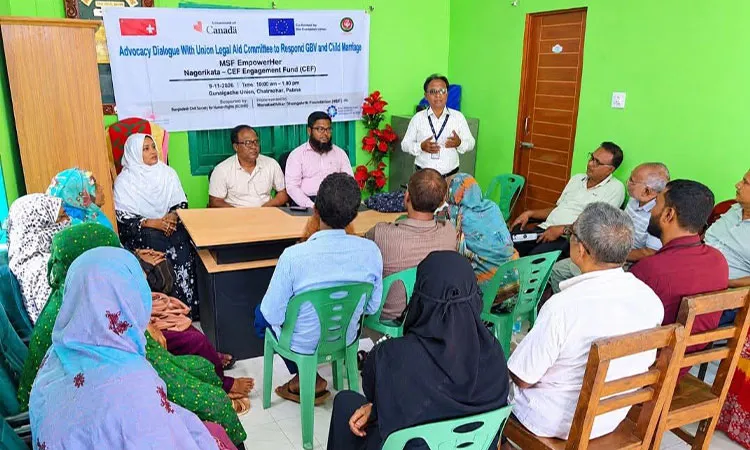
Poverty, social inequality and a lack of legal awareness frequently prevent marginalized citizens from accessing justice. Across Pabna district, social challenges including violence against women and children, child marriage and gender-based discrimination remain major barriers to building an equitable society.
To address these issues at the grassroots level, the Manobadhikar Sanskriti Foundation (MSF) is implementing two targeted initiatives in Pabna: Defending Human Rights Through Network Strengthening (DHRNS) and EmpowerHer. Led by prominent human rights activist Advocate Sultana Kamal and Chief Executive Advocate Md. Saidur Rahman, MSF is executing both programmes in partnership with the local development organisation Bachte Chai Samaj Unnayan Samiti.
DHRNS: Building a Local Watchdog Network
Operating across nine upazilas of Pabna, the DHRNS project coordinated by Sofia Hasin focuses on building an active local network of human rights defenders. The initiative brings together lawyers, journalists, educators, activists and socially conscious citizens to monitor rights violations, investigate incidents, prepare fact-finding reports and assist victims.
Beyond direct victim support, DHRNS organises public awareness campaigns, advocacy dialogues, human chains and press briefings. By working alongside both government and non-government institutions, the project aims to strengthen social accountability and ensure timely intervention when rights are violated.
Empower Her: Grassroots Women’s Empowerment in Chatmohar
To combat gender-based violence and build financial and social resilience the MSF’s EmpowerHer project coordinated by Naznin Shabnam operates across all 11 unions of Chatmohar Upazila. The initiative organises rural and marginalized women into active groups of 30 members per union, holding regular monthly meetings, workshops and quarterly reviews.
The project connects rural women with government skills-training programmes to foster self-reliance while partnering with local public representatives and administrative bodies to prevent domestic abuse, sexual violence, and child marriage. To date, EmpowerHer has directly benefited over 700 women and reached approximately 24,500 indirect beneficiaries across the upazila.
Bridging the Gap to Legal Justice
For many abuse survivors, financial hardship stops them from pursuing legal remedies. Both DHRNS and EmpowerHer provide targeted litigation support to eligible victims while bridging the gap between rural communities and state-funded legal services.

In Pabna, indigent justice-seekers receive free legal representation through the District Legal Aid Office. District Legal Aid Officer and Senior Civil Judge Md. Azharul Islam has played a vital role in expanding this support, particularly in helping women recover denmohor (dower) and maintenance in family disputes. Complementing these efforts, EmpowerHer hosts advocacy dialogues with Union Parishads in Chatmohar to activate Union Legal Aid Committees and simplify access to government legal aid for vulnerable residents.
A Shared Civic Responsibility
At the district level, MSF’s District Human Rights Monitoring Officer (DHRMO) Kamal Ahmed Siddiqui coordinates field monitoring, victim support and inter-agency collaboration. He notes that protecting human rights cannot rest on any single institution rather, it requires shared accountability across the state, families and citizens.
While DHRNS and EmpowerHer operate within distinct scopes both share a unified mission ensuring that justice is treated not as a privilege but as a fundamental right accessible to every citizen. Lasting change, however, depends on sustained collaboration among the administration, judiciary, law enforcement, media and local communities to uphold human dignity and protect women and children from discrimination.