


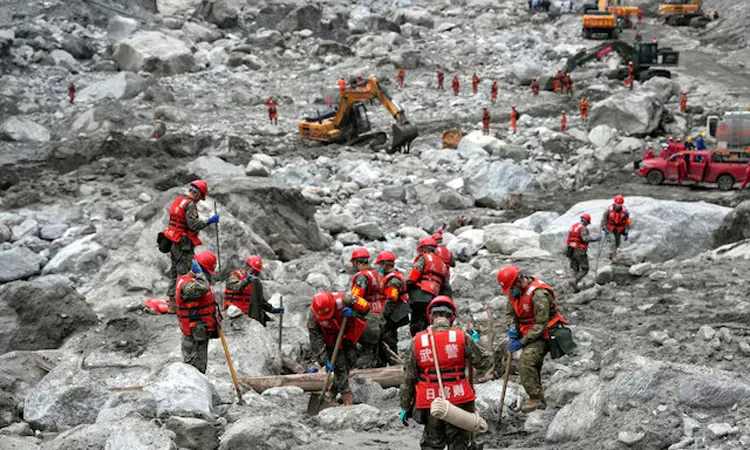
Chinese rescue teams continued their search Sunday at the Gyirong border crossing, using excavators, shovels and ground-penetrating radar to locate hundreds still missing after a massive glacial mudslide destroyed the key China-Nepal border point on August 26.
The disaster, triggered by a glacier collapse on Nepal's side of the border, wiped out the five-storey Chinese customs building entirely. Only part of a nearby water tower remained standing. A Chinese flag now marks the spot where the 20-meter-tall border gate once stood.
Reuters and other foreign media outlets visited the site as part of the first press trip organized by China's foreign ministry since the disaster. Around 20 rescue workers dug through debris in hazard zones marked "Danger Area Pass Quickly" while excavators stood by. Officials said the search area has been divided into seven zones with four already cleared and three still underway.
The mudslide has killed more than 1,300 people across both countries with over 5,000 still missing. In China alone, 31 deaths have been confirmed and 531 people remain unaccounted for 261 foreign nationals from 23 countries among them 49 Indian citizens, many believed to be Hindu pilgrims traveling to Mount Kailash.
On Saturday the rescuers in Nepal pulled a Chinese worker alive from a tunnel connected to a hydropower station.
Gyirong, situated at over 4,000 meters altitude has faced continued landslide risks, harsh weather and deep mud, slowing recovery efforts. The only access road was restored Wednesday also allowing heavy machinery to reach the site. Power has also been partially restored using temporary electric poles.
The crossing has served as the primary trade and travel route between Nepal and Tibet for the past decade of following damage to an alternate route in the 2015 Nepal earthquake.

