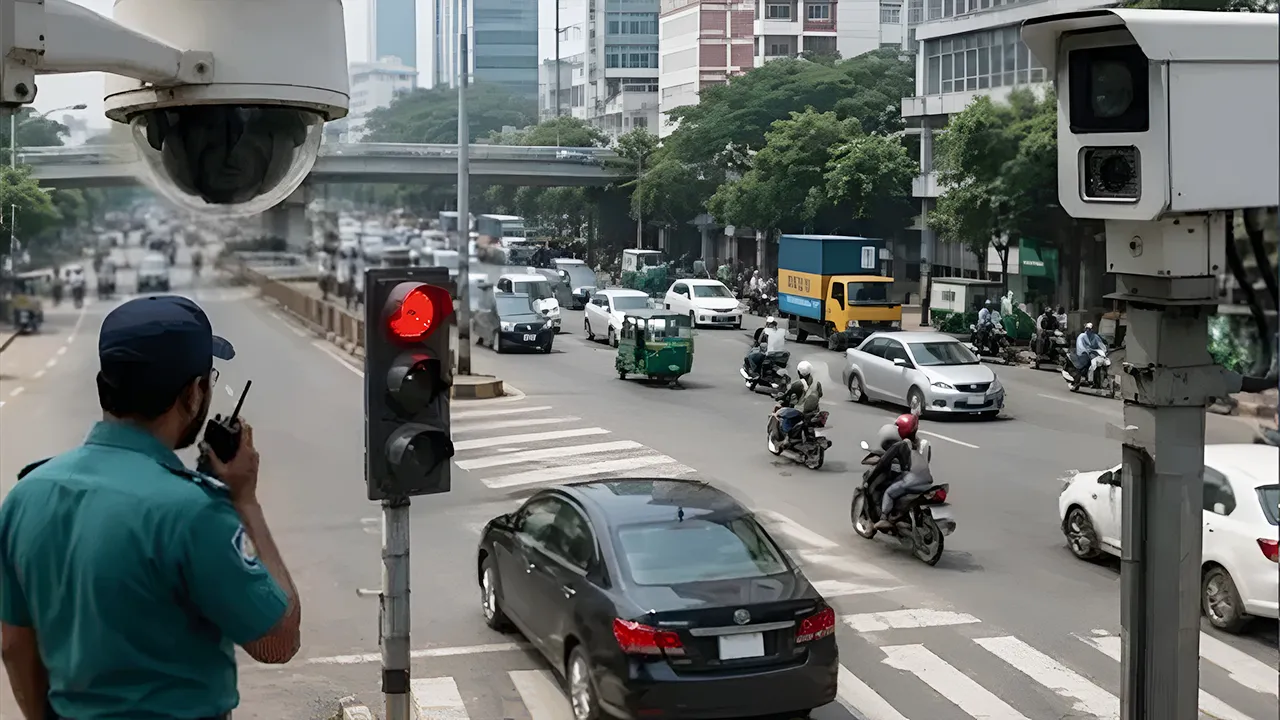
The government plans to make AI-powered traffic signal systems operational at 50 key points in Dhaka within the next two months as part of efforts to reduce traffic congestion in the capital.
Prime Minister Tarique Rahman disclosed the plan on Wednesday, 18 November, during the question-and-answer session in parliament. He was responding to a supplementary question from Cumilla-9 MP Md Abul Kalam.
The lawmaker said traffic congestion causes more than Tk 37,000 crore in economic losses in Bangladesh every year, mainly due to lost working hours and excessive fuel consumption.
He also noted that AI-based traffic systems had been introduced along the route from Shaheed Jahangir Gate to Sadarghat in Dhaka and on the Dhaka–Chattogram highway after the current government took office. According to him, the technology automatically detects traffic violations and has helped reduce accidents and congestion.
Abul Kalam asked whether the prime minister would direct the authorities to bring all major roads in Dhaka and important highways across the country under AI-based traffic management.
In response, Tarique Rahman said no fresh directive was necessary, as the relevant departments had received instructions three months earlier. Work was already underway to install AI camera-equipped traffic signal lights at 50 important points in Dhaka.
The prime minister said city residents could already see the new signals being installed at different locations, although they were not yet fully operational. The government expects the systems to become functional within two months.
He expressed hope that the introduction of the AI-powered signals would bring significant improvements to traffic management in the capital and substantially reduce congestion.
Referring to other densely populated cities around the world, Tarique Rahman said major capitals typically experience some traffic congestion for two to four hours during morning office and school commutes and again in the afternoon when people return home. Bangladesh faces a similar situation, he said, adding that the government was working to minimise the inconvenience. Government considers monorail for densely populated areas The prime minister also outlined the government's long-term plans to improve urban transport. Several metro rail routes are already operational, while steps are being taken to complete work on the remaining routes more quickly.
Alongside metro rail expansion, the government is giving serious consideration to introducing a monorail system to make daily travel easier and more comfortable for residents.
Tarique Rahman said monorails could operate through relatively narrow spaces, making them suitable for densely populated areas. This could allow the system to serve inner roads in neighbourhoods such as Mohammadpur, Dhanmondi and Sabujbagh.
He said implementing the plan could bring substantial benefits to people's daily commutes.