The Asian Infrastructure Investment Bank (AIIB) has signed a record $1.6 billion financing agreement with COP31 host Turkey to support policy reforms aimed at attracting climate investments as the bank announced on Thursday.
The deal unveiled on the fourth day of the UN climate summit in Antalya will help Turkey implement its Climate Law and reach net-zero emissions by 2053. AIIB Chief Investment Officer Konstantin Limitovskiy called it the bank’s largest climate policy-based financing package to date. Turkey is a founding AIIB member, requires an estimated $68 billion in additional climate investment by 2030 roughly half from private sources to tackle growing threats from droughts, wildfires and floods.

The funding covers fiscal policy, financial regulation and sectoral planning. Key targets include scaling Turkey’s nascent emissions trading scheme with at least 180 high-emitting facilities reporting baseline emissions by April 2027 to help exporters like steel and cement makers offset the European Union’s carbon border levy. By early 2027, the programme also aims to secure production licences for 1,800 megawatts of wind and solar power. Additionally by 2028, it seeks to transition 225,000 farmers in water-stressed regions to less water-intensive crops and designate 50,000 hectares of land as carbon sinks.

Resilient Cities and Clean Energy in Focus
The announcement came as world leaders gathered in Antalya for the second and final day of their high-level summit. Discussions focused on methane cuts, resilient urban infrastructure and expanding electrification in buildings and transport. Alongside the leaders' meeting, a business forum opened to mobilise private investment for power grid upgrades and energy-efficient buildings.

Bangladesh Urges Climate Grants Over Loans
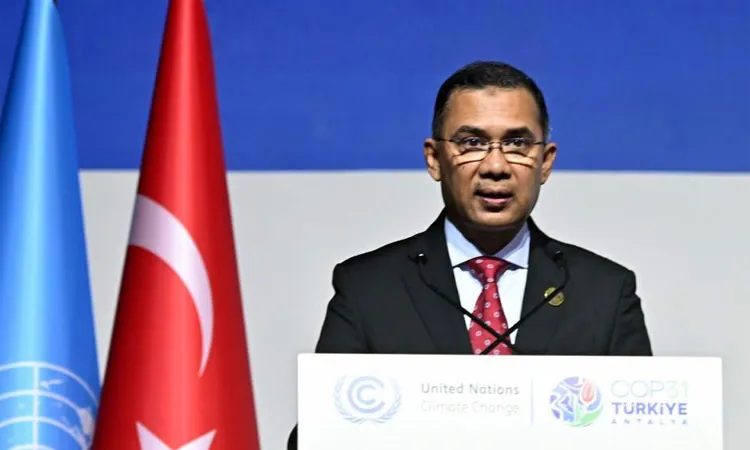
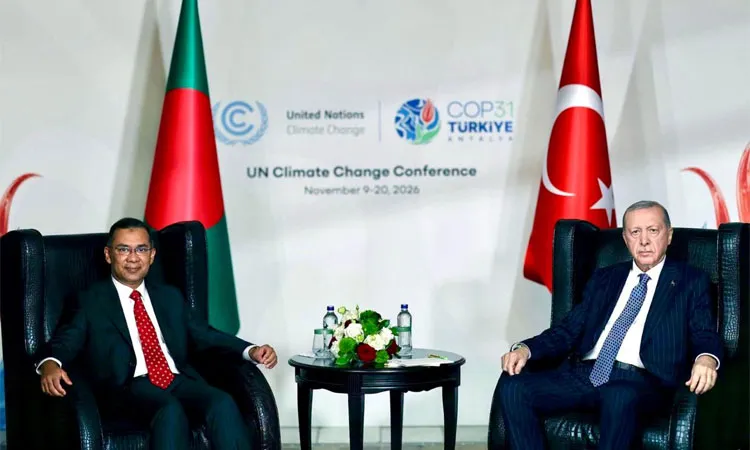
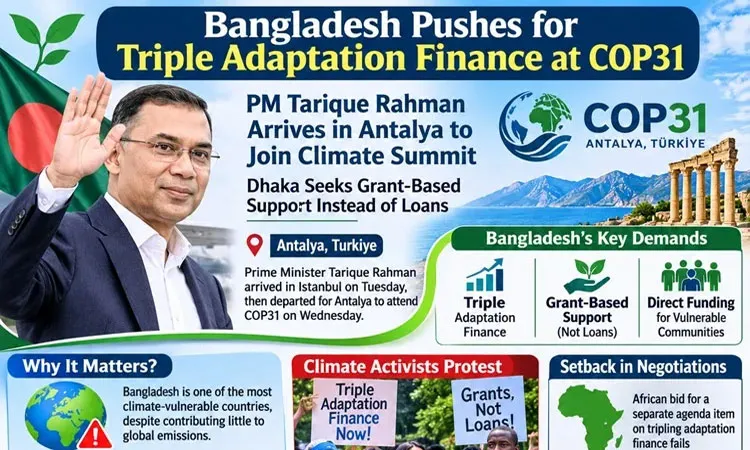
Addressing the summit on Thursday, Bangladesh Prime Minister Tarique Rahman called for fair access to green technology and a "just" energy transition for developing nations.
"Climate-vulnerable countries need grants and not more loans that increase their debt" Tarique Rahman said with noting that climate losses heavily burden Bangladesh’s economy despite the country contributing less than 0.5 percent of global greenhouse gas emissions.
He urged rich nations to allocate at least 50 percent of international climate finance to adaptation and introduce debt-for-climate swaps. Highlighting domestic efforts, PM Tarique Rahman added that Bangladesh plans to generate 20 percent of its electricity from renewable sources by 2030 including developing 4,000 megawatts of solar power alongside waste-to-energy and green industry initiatives.