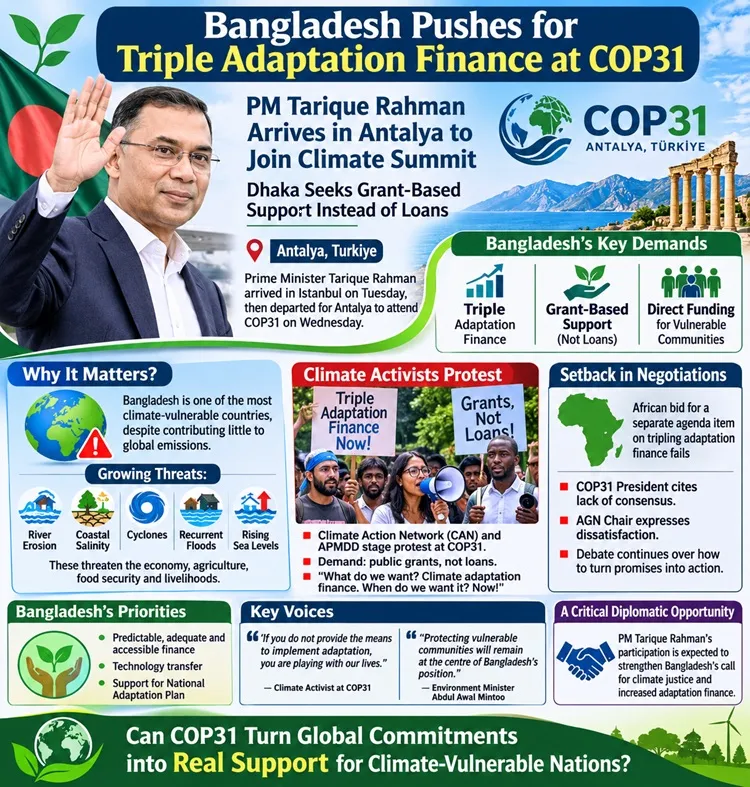
Bangladesh is set to press for a threefold increase in climate adaptation finance, grant-based assistance instead of loans, and direct funding for vulnerable communities at the UN Climate Change Conference COP31, as Prime Minister Tarique Rahman arrived in Antalya, Turkiye, to attend the summit.
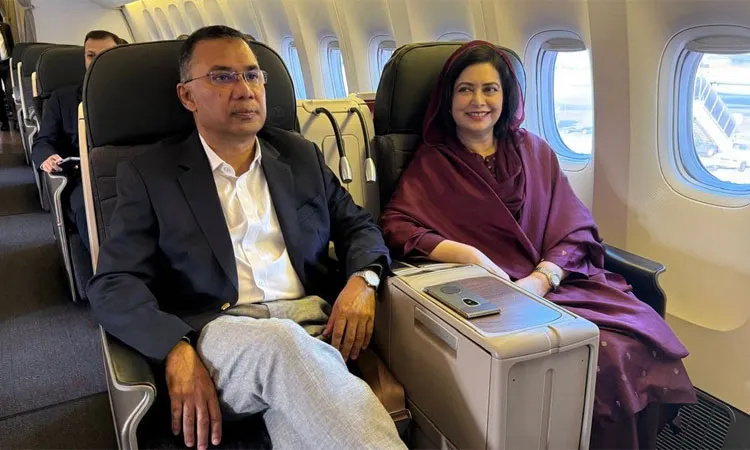
The Prime Minister arrived in Istanbul at 12:40 pm local time on Tuesday aboard a Turkish Airlines flight from Dhaka. After a brief stopover, he departed for Antalya at 2:55 pm on another Turkish Airlines flight.
Rahman is scheduled to attend the climate summit on Wednesday. He is also expected to hold bilateral meetings with several heads of state and government on the sidelines of the conference.
For Bangladesh, one of the countries most vulnerable to climate change despite contributing relatively little to global greenhouse gas emissions, COP31 presents an important opportunity to strengthen its international position on climate justice and secure adequate financial and technological support.
River erosion, coastal salinity, cyclones, recurrent floods and rising sea levels continue to threaten the country’s economy, agriculture, food security and livelihoods. Bangladesh therefore considers predictable, accessible and adequate adaptation finance essential to implementing its national adaptation plans.
The Prime Minister’s participation is expected to provide an opportunity to highlight the country’s priorities at the highest diplomatic level.
Rahman left Dhaka at 7:30 am on Tuesday with his wife, Dr Zubaida Rahman. Upon arrival in Istanbul, he received a VVIP welcome at the airport. Dr M. İlker Haktankaçmaz, the airport’s administrative chief and governor, welcomed him.
Climate activists protest over funding gap
Meanwhile, climate justice activists staged a protest at the Blue Zone of COP31 on Tuesday morning, demanding greater adaptation finance for developing countries and criticising the failure to include a separate agenda item on tripling adaptation funding.
The protest was organised by Climate Action Network (CAN) and the Asia Pacific Movement on Debt and Development (APMDD).
Among those present were climate campaigner Harjeet Singh, CAN Executive Director Tasneem Essop and Baboucar Nyang, a Gambian climate activist and regional coordinator of CAN Africa.
The demonstrators called for public grant-based financing instead of loans and urged negotiators to ensure that funds reach climate-vulnerable communities directly.
They expressed frustration over the gap between international financial commitments and the actual resources reaching people on the front lines of climate change.
Speakers cited Nepal and Mozambique as examples of countries facing severe climate impacts without receiving adequate resources to protect their populations.
Questioning the emphasis on indicators under the Global Goal on Adaptation (GGA) without corresponding financial commitments, one speaker said Nepal had never received the funding it sought to protect itself against the risk of glacial lake outburst floods.
“If you do not provide the means to implement adaptation, you are playing with our lives,” the speaker said, calling for needs-based public grants rather than loans that could deepen the debt burden of developing nations.
The activists repeatedly chanted: “What do we want? Climate adaptation finance. When do we want it? Now!”
They pledged to continue raising the demand throughout the conference.
African proposal fails to secure separate agenda
The controversy intensified after the African Group of Negotiators (AGN) failed on Monday to secure a separate agenda item on tripling adaptation finance for developing countries.
Ghana submitted the proposal on behalf of the African group, seeking formal discussions on the implementation of the commitment made at COP30 in Belem, Brazil, to at least triple adaptation finance for developing countries by 2035.
The proposal aimed to establish a dedicated platform to assess progress, identify funding sources and discuss accountability for delivering the commitment.
However, COP31 President Murat Kurum said there was no consensus among the parties to include the proposal as a separate agenda item. As part of a compromise, a broader climate finance work programme was agreed upon to facilitate further discussions.
AGN Chair Nana Antwi-Boasiako Amoah expressed dissatisfaction with the outcome but said the African group would continue pursuing the issue through other negotiating channels.
The decision exposed differences among negotiating blocs over how climate finance commitments should be translated into concrete action.
The Umbrella Group, represented by the United Kingdom, maintained that adaptation finance was not an orphan issue and would continue receiving adequate attention in the negotiations. India expressed disappointment over the outcome, while the European Union also raised concerns about the handling of several agenda items.
Bangladesh calls for grants, not loans
For Bangladesh and other climate-vulnerable developing countries, the issue is not simply the amount of money available but also the terms and accessibility of financing.
Developing countries argue that they should not have to take on additional debt to deal with a crisis they have contributed relatively little to creating. They want a substantial share of adaptation finance to come in the form of public grants and highly concessional support.
Article 9.1 of the Paris Agreement establishes the obligation of developed countries to provide financial resources to developing countries for climate action.
Bangladesh is also placing particular emphasis on protecting vulnerable communities and securing the finance and technology needed to implement its National Adaptation Plan.
Environment Minister Abdul Awal Mintoo has said that protecting climate-vulnerable communities will remain at the centre of Bangladesh’s position. Ensuring adequate financing and technology for the implementation of the country’s adaptation plans will also be a key priority.
For Bangladesh, the issue has immediate implications. Coastal salinity, river erosion, recurrent floods and extreme weather events threaten livelihoods, food security and essential services across the country.
The government needs predictable and accessible financial support, technology transfer and capacity-building assistance to strengthen adaptation efforts. Grant-based financing is particularly important to prevent climate-related challenges from adding to the country’s existing economic pressures.
A critical diplomatic opportunity for Bangladesh
Apart from adaptation finance, the COP31 negotiations are also addressing just transition, technology transfer and unilateral climate-related trade measures.
The African group has expressed concern that unilateral climate trade policies could unfairly shift the cost of emissions reduction onto developing countries that bear relatively little responsibility for global warming.
The debate over climate finance has once again highlighted the widening gap between international promises and the actual support received by vulnerable nations.
For Bangladesh, the success of COP31 will depend not only on new commitments but also on whether adequate resources are delivered to communities facing the consequences of climate change.
Prime Minister Tarique Rahman’s participation offers Bangladesh an important diplomatic opportunity to reinforce its demands for climate justice, increased adaptation finance and grant-based international assistance.
The key question now is whether the Antalya summit can translate global commitments into tangible financial support for countries and communities most exposed to the climate crisis.