


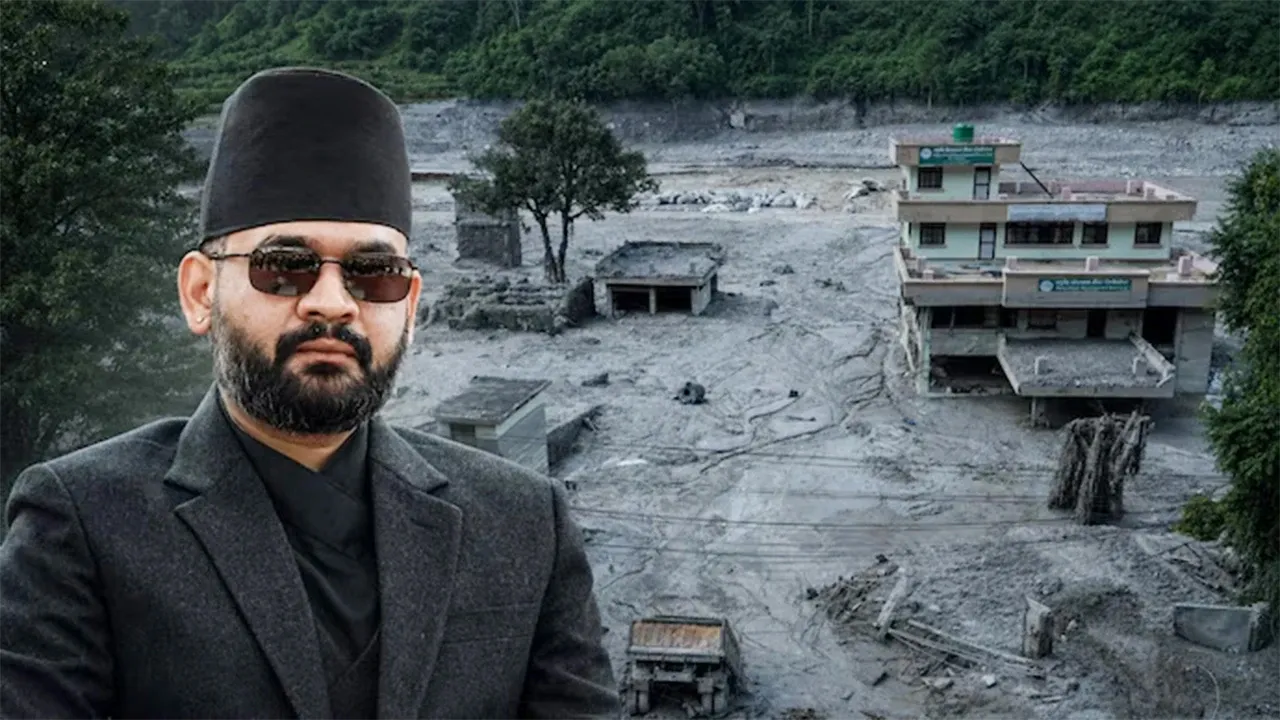
Nepal is seeking climate compensation from major greenhouse gas emitters, including China, India and the United States, after devastating floods killed more than 1,100 people and caused extensive damage across the country.
Nepal argues that countries most responsible for global greenhouse gas emissions have a responsibility to compensate vulnerable nations suffering severe losses from climate-related disasters. The claim was reported by India Today.
Nepal’s Foreign Minister Shishir Khanal said the country is changing its diplomatic approach from seeking assistance to demanding climate justice and compensation.
“We are shifting our diplomatic framework from aid to justice and compensation,” Khanal told Kantipur TV.
He argued that the recent disaster in Rasuwa should not be viewed solely as a humanitarian crisis requiring donations or relief.
“This is not about charity; it is about legal and moral responsibility,” Khanal said.
Khanal identified China, the United States and India as the world’s three largest greenhouse gas emitters and said countries such as Nepal, which contribute relatively little to global warming but face severe consequences, deserve compensation.
Nepal is considering sending Prime Minister Balendra “Balen” Shah to the 81st session of the United Nations General Assembly (UNGA) to strengthen the country’s case for climate compensation at the international level.
According to The Kathmandu Post, a proposal for Shah to travel to New York is currently under discussion.
Nepal’s demand comes as the country struggles with the aftermath of a catastrophic flood in the Bhotekoshi River basin.
The Bhotekoshi River flood struck on August 26, severely affecting parts of Rasuwa, Nuwakot and Dhading districts in Bagmati Province.
At least 1,127 people have reportedly been killed, while around 3,900 remain missing. The disaster damaged homes, roads, bridges and hydropower projects, leaving thousands displaced.
Nepal has described the disaster as a “Himalayan tsunami.”
According to Nepal Police data, more than 1,100 deaths had been confirmed by September 1, while thousands of people remained missing.
Authorities and experts believe the flooding originated in the high mountainous region near the Nepal-China border. However, further scientific research is needed to establish the precise cause of the disaster and determine the extent of its connection to climate change.
Preliminary assessments have pointed to rock and ice avalanches, unstable glaciers and changes in the Himalayan ecosystem as possible contributing factors.
The disaster has also raised concerns over the safety of infrastructure projects built by China in the fragile and earthquake-prone Himalayan region.
Nepal’s Finance Minister Swarnim Wagle told Reuters last week that the country could require between $4 billion and $5 billion to rebuild infrastructure destroyed by the floods.
That amount is equivalent to roughly 10% of Nepal’s economy, underscoring the scale of the damage.
Nepal has also formally applied for emergency financial assistance from the UN-backed Fund for Responding to Loss and Damage, seeking support to address the consequences of the disaster.

