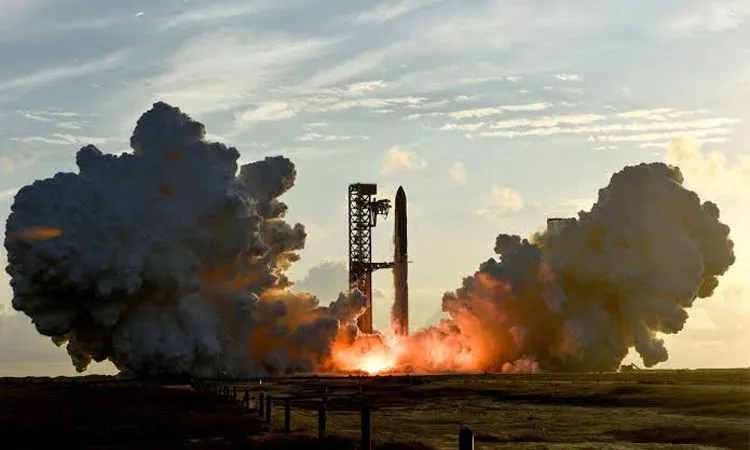

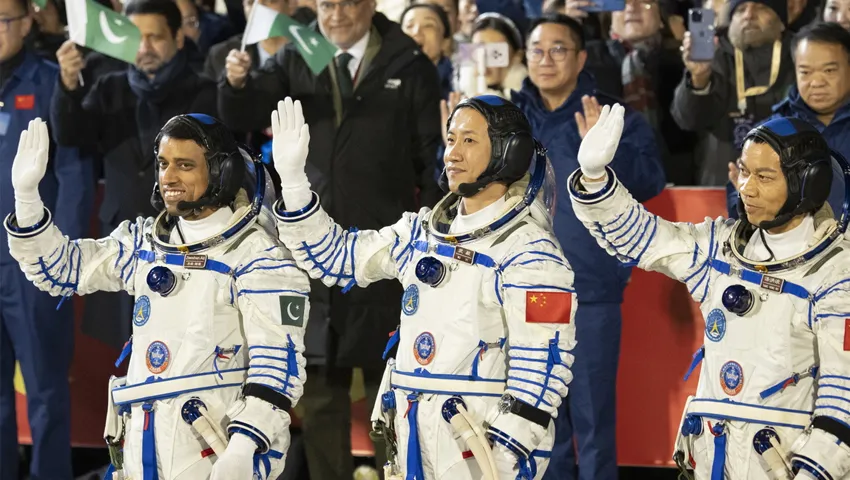
China launched the Shenzhou 24 spacecraft on Wednesday morning, carrying two Chinese astronauts and Pakistan’s first astronaut to its Tiangong space station in a historic milestone for both nations.
The crew comprising Pakistani astronaut Muhammad Zeeshan Ali (40) alongside Chinese astronauts Tang Hongbo (51) and Wu Yi (39) lifted off from the Jiuquan Satellite Launch Center in northwestern China. The spacecraft successfully separated from its rocket and entered its designated orbit, marking the first joint flight with a foreign astronaut in China’s human spaceflight history.
In Pakistan, citizens, restaurant patrons, and scientists at the national space agency watched the live broadcast with cheers celebrating Pakistan-China friendship. Speaking from the launch site, Pakistan’s Planning Minister Ahsan Iqbal thanked Chinese President Xi Jinping and China's scientific leadership, noting that Ali carried Pakistan’s technological aspirations into orbit.
"The sky is no longer our limit, it is our launching pad," Iqbal said, adding that Pakistan will eventually send astronauts into space independently.
Conducted under a February 2025 bilateral agreement, the mission includes over 90 scientific experiments and technology tests, according to China's Xinhua News Agency. During his short-term stay, Ali will study photosynthetic cyanobacteria in orbit before returning to Earth aboard the Shenzhou 23 spacecraft.
The flight is the space debut for both Ali and Wu, while mission commander Tang becomes the first astronaut to visit the Tiangong station three times, state broadcaster CCTV reported. Ahead of the launch, Tang noted that the crew overcame cultural and language barriers through intensive training evidenced by Ali quoting classical Chinese poetry in Mandarin at Tuesday's press conference. Ali expressed hope that bilateral space cooperation will soon expand to the Moon and Mars.
The milestone comes as China prepares for its first crewed lunar landing by 2030, trailing rival NASA’s 2028 Moon landing target.