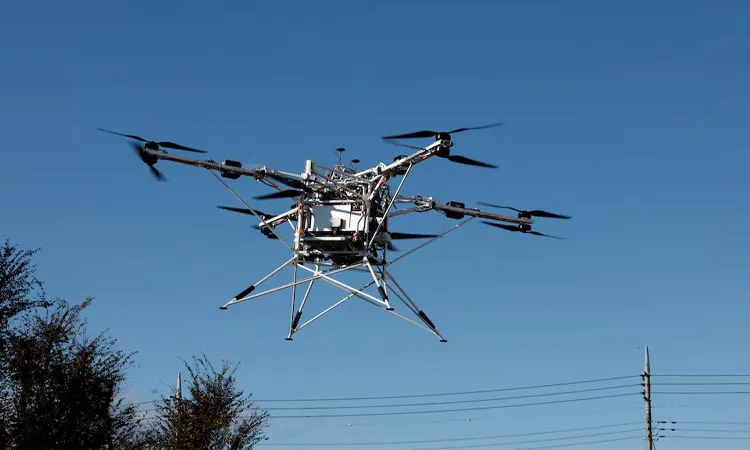
Facing fierce competition from Chinese rivals, Japan’s struggling auto parts manufacturers are finding new business in the defense sector as Tokyo pushes for its largest military buildup since World War Two.
Under Prime Minister Sanae Takaichi, the government is urging the country’s vast automotive supply chain to help strengthen national security against regional threats from China, Russia and North Korea. The effort is backed by the United States also provides a financial lifeline to an industry that produced nearly 900,000 fewer vehicles in 2025 than a decade earlier.

Japan’s Acquisition of Technology & Logistics Agency (ATLA) is actively evaluating auto suppliers also pairing them with defense contractors and offering millions of dollars in funding for prototype development. A primary focus is building fleets of attack and interceptor drones. Currently, domestic drone production is minimal Japan exported just over 1,100 unmanned aerial vehicles last year, compared to roughly 123,000 exported by Taiwan.

Several smaller manufacturers have already made the pivot. Aster, a longtime parts supplier for Toyota is now earns 10 percent of its revenue making electric motors for US defense tech firm Anduril’s drones. Similarly the engine-part maker Kyowa Industrial saw its defense sales jump from 3 percent in spring 2025 to 10 percent this year, driven by prototype drone engine orders. Racing-part manufacturer Kaaz is also developing military drone engines in consultation with ATLA.
Industry experts note that Japan’s 70,000 automotive companies possess the exact precision engineering, electronics expertise and mass-production capabilities needed to replenish global arsenals strained by conflicts in Europe and the Middle East.
However, entering the defense sector remains sensitive in a nation shaped by decades of postwar pacifism. Japan’s "Big Three" automakers the Toyota, Honda, and Nissan remain reluctant to join the military push due to reputational concerns and their heavy business ties to China. This hesitation has made some of their direct suppliers cautious about taking on military contracts.
Even so, shifting security concerns are softening public resistance. When Aster Chief Executive Takenobu Hongo told his 100 factory workers last November about supplying motors for US military drones, he expected pushback. Instead, staff welcomed the news. As regional tensions grow, Hongo believes more Japanese manufacturers will follow suit.