Emphasizing the need to reduce reliance on traditional export products and focus on emerging sectors, Commerce Minister Khondokar Muktadir Abdul Muktadir has stated that Bangladesh can build a robust and internationally benchmarked Halal ecosystem by leveraging the experience of the ASEAN region.
He noted that such an ecosystem would play a crucial role in diversifying the country's export basket in the future.
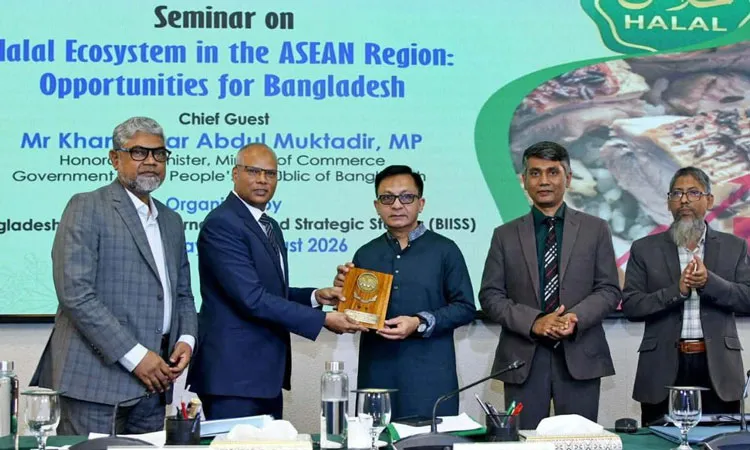
The minister made these remarks while addressing a seminar titled "Halal Ecosystem in the ASEAN Region: Prospects for Bangladesh," organized by the Bangladesh Institute of International and Strategic Studies (BIISS) on Tuesday.
Commerce Minister Muktadir highlighted that the Halal economy is no longer limited to food and beverages alone. Today, it has evolved into a massive global economic framework encompassing food, pharmaceuticals, cosmetics, modest fashion, tourism, logistics, technology, finance, and international certification.
"To boost exports, we must first enhance our production capacity. This requires both domestic and foreign investments, along with ensuring a safe and attractive environment for investors," the minister said.
Highlighting the importance of retaining export competitiveness after Bangladesh's graduation from the Least Developed Country (LDC) status, the Commerce Minister shared that initiatives are underway to sign Free Trade Agreements (FTAs), Preferential Trade Agreements (PTAs), and Economic Partnership Agreements (EPAs) with various nations to secure preferential market access for Bangladeshi goods.
He further stressed that to capitalize on opportunities in the global Halal market, the country needs to establish an independent, reliable, and internationally recognized Halal certification framework. This would enhance global trust in Bangladeshi products and facilitate expansion into new markets.
Speakers at the seminar noted that while Bangladesh's export sector has long been dominated by ready-made garments, diversification in both products and markets is essential to remain competitive in future global trade. In this context, the Halal economy presents a promising major frontier.
They emphasized that global demand for Halal products is growing rapidly across sectors including pharmaceuticals, cosmetics, fashion, tourism, and lifestyle products alongside food. To effectively enter this market, integrated production, quality control, and certification systems are imperative.
During the discussion, Malaysia’s Halal ecosystem was cited as a model for Bangladesh to emulate. Panelists pointed out that Malaysia treats Halal not merely as a product or certificate, but as a complete economic framework integrating production, research, certification, marketing, and exports.
Speakers highlighted that Bangladesh possesses a large domestic market, a strong agriculture and food-processing sector, an internationally recognized pharmaceutical industry, a leather sector, and vast experience in garment manufacturing. By leveraging these existing strengths, Bangladesh could become a key player in the global Halal supply chain.
The seminar outlined five strategic priorities to make Bangladesh’s Halal sector globally competitive: Developing an internationally acceptable national Halal assurance framework. Establishing specialized Halal industrial clusters equipped with modern laboratories and advanced logistics facilities. Upgrading existing production sectors to meet international standards. Engaging SMEs and young entrepreneurs.
Promoting the "Bangladesh Halal Brand" in the global market through economic diplomacy.
BIISS Director General Major General A.S.M. Ridwanur Rahman delivered the welcome address, while Director of Research Dr. Mahfuz Kabir presented the keynote paper.
The panel discussion featured Aktar Hossain, Deputy Director of the Halal Certification (Livestock) Division at Islamic Foundation, and S.M. Abu Sayed, Deputy Director (Halal Certification) at the Bangladesh Standards and Testing Institution (BSTI).
Panelists concluded that if religious values are aligned with product quality, safety, transparency, and international credibility, the Halal economy can become a new pillar for Bangladesh's exports. With coordinated government initiatives, private investment, and international cooperation, Bangladesh can position itself not only as an exporter of Halal goods but also as a vital hub in the global Halal market.