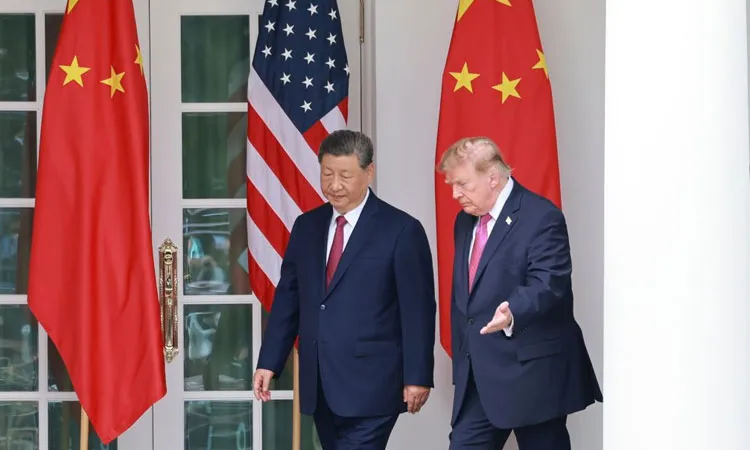
US President Donald Trump hosted Chinese President Xi Jinping at the White House on Thursday for a high-profile state visit heavy on symbolism but sparse on tangible policy breakthroughs.
The bilateral meeting Xi’s first visit to Washington in over a decade addressed pressing geopolitical concerns including trade, military dialogue, artificial intelligence and Taiwan without yielding major structural agreements.

Speaking at a White House welcome ceremony, President Xi emphasized that bilateral relations have reached "another historical juncture." He called for strategic stability, healthy economic competition and stronger crisis-prevention mechanisms between both militaries. Xi also stressed the need to maintain human control over emerging artificial intelligence technologies.

On Taiwan, Xi urged the US to oppose "Taiwan independence" reiterating Beijing’s stance on the island. The discussion follows Trump's decision earlier this year to hold a $14 billion arms package to Taipei in abeyance as a negotiating lever a move that raised concerns among congressional Republicans and Asian allies.

President Trump highlighted his personal rapport with Xi and emphasizing enduring people-to-people ties despite differing governance systems. However the summit coincided with pressing external challenges for the US administration including rising energy costs linked to ongoing conflict in the Middle East and domestic debate over technology export controls.
The visit concluded with a state dinner attended by prominent technology executives, including CEOs from Apple, Alphabet, Tesla, OpenAI and Nvidia. Despite the high-level engagement also analysts note that deep-seated strategic competition in high-tech sectors and defense is likely to limit broader policy convergence in the near term.