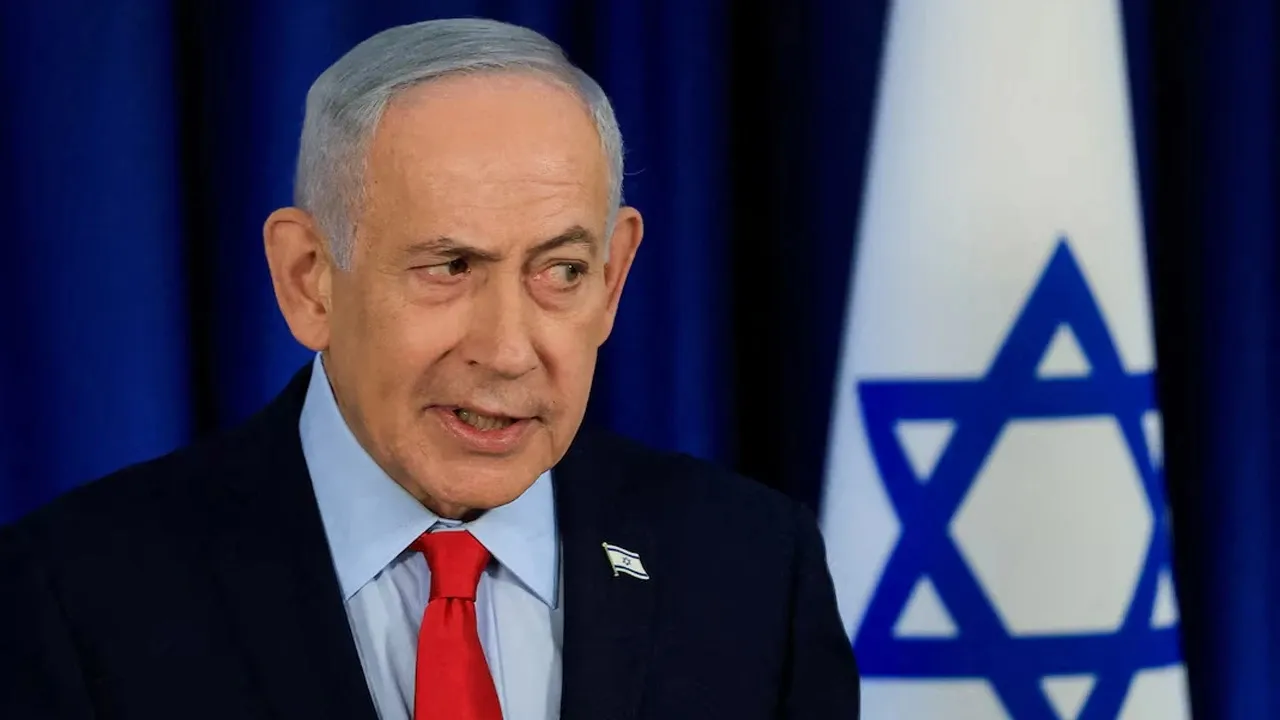
Israeli Prime Minister Benjamin Netanyahu has reportedly been considering a fresh military operation against Iran despite losing his parliamentary majority in last month's election and now leading a caretaker government.
Netanyahu remains in office following a political deadlock, with his government expected to continue in a caretaker capacity until a new administration is formed. Opposition parties are struggling to build a governing coalition, a process that could take several months.
Despite his weakened political position, Netanyahu is reportedly exploring the possibility of renewed military action against Iran. However, the United States, senior Israeli military officials and political rivals seeking to replace him appear reluctant to support another conflict.
This raises two important questions: Does Netanyahu's caretaker government have the legal authority to take Israel into another war, and how would such a decision be received domestically? What Military Powers Does an Israeli Caretaker Government Have? Formally, an Israeli caretaker government enjoys almost the same powers as a regular government.
Article 30 of Israel's Basic Law states that the outgoing government continues to exercise its responsibilities until a new government takes office.
However, Israel's Supreme Court has previously ruled that an outgoing government should avoid major policy decisions that cannot easily be reversed, except when urgent circumstances require them. This principle is known as the duty of restraint.
In practice, however, Netanyahu could obtain approval from his caretaker government to launch a military operation by presenting it as an emergency measure serving the national interest.
Neve Gordon, a professor of international law at Queen Mary University of London and author of Israel's Occupation, told Al Jazeera that such a justification could provide the legal basis for military action.
Or Asher, a researcher at the Tel Aviv-based Tachlith Institute, told Reuters that security matters are among the clearest exceptions to the duty of restraint imposed on caretaker governments.
He noted that Israel's Supreme Court has historically avoided intervening in decisions to launch wars. Parliamentary oversight is also at its weakest during the weeks between the opening of a new Knesset session and the formation of parliamentary committees.
According to Asher, a caretaker prime minister can legally take Israel into war, including a conflict with Iran.
However, Ehab Jabarin, a Palestinian citizen of Israel and political analyst, told Al Jazeera that Netanyahu's caretaker status would increase his political responsibility to justify such a decision.
He said Netanyahu would have to persuade the public to accept the consequences of a military operation whose effects could continue long after his government leaves office.
Is Netanyahu Preparing to Resume the War Against Iran? Israeli media reported on Wednesday that the security cabinet, chaired by Netanyahu, had instructed the military to intensify preparations for a possible attack on Iran.
According to Israel's public broadcaster Kan, the instructions could lead to military activities capable of triggering a new war.
Earlier reports suggested that Netanyahu had repeatedly contacted US President Donald Trump to press him to support another military campaign against Iran. Israeli news outlet Ynet reported that at least one of their conversations became heated.
On Thursday, a US military official told Kan that Washington had informed Israel to prepare for a possible new round of hostilities.
However, the US Central Command (CENTCOM) subsequently rejected the report, describing the claims to Al Jazeera as "pure speculation".
A report by Israel's Channel 13 said senior military officials believed there was no urgent need to attack Iran.
The broadcaster reported that this assessment was presented to Netanyahu and opposition leader Gadi Eisenkot during a briefing on Wednesday. Eisenkot has been tasked with efforts to form the next government. What Are Israel's Opposition Parties Saying? Opposition parties have warned Netanyahu against taking military action unless there is an urgent necessity.
Avigdor Lieberman, leader of the Yisrael Beiteinu party and a member of the opposition bloc, said the caretaker prime minister should not make decisions that could drag Israel into war without parliamentary oversight and the full consent of senior security officials.
Eisenkot expressed a similar position in a letter sent to Netanyahu on Wednesday.
He warned that deploying Israeli forces in the absence of a direct and immediate threat that could not be addressed through waiting could have serious consequences for Israeli democracy and public confidence in state institutions.
In response, Netanyahu insisted that his government makes all decisions solely on the basis of security considerations.
How Could Israelis React to Another War? A renewed conflict could deepen political divisions within Israeli society.
Neve Gordon said those who voted for Netanyahu and his coalition parties would likely support military action. However, most supporters of the so-called change bloc would be angered by what they might view as an attempt to use war to remain in power and prevent an electoral victory by his opponents.
Nevertheless, Gordon suggested that most people who voted against Netanyahu's coalition could eventually rally around the national flag if another conflict erupted.
Jabarin also believes that Israelis would probably support their government if a new war began and missiles were fired towards the country.
However, he cautioned that public unity during an attack would not necessarily mean people believed Netanyahu had made the right decision by starting another conflict.
He said the real test would come when reservists were called up again, families were forced back into shelters and the government had to explain how a new operation could achieve objectives that the previous campaign had failed to accomplish.
According to Jabarin, the central question in any renewed confrontation with Iran would be: "Why now?"
He argued that if the justification for immediate military action was weak, particularly in the face of US opposition and objections from senior Israeli military officials, the decision could be viewed as an attempt to change the course of domestic political developments.
This concern is particularly significant as Eisenkot works to form a new government.
US Reluctance Could Be a Major Obstacle Beyond domestic political considerations, the position of Israel's most important ally, the United States, could pose a significant obstacle to Netanyahu's plans.
Washington has indicated that it is intensifying its economic pressure campaign against Iran rather than pursuing another major military offensive.
Gordon said Netanyahu's biggest problem was not necessarily the Israeli public but the apparent decline in US interest in another war.
Anders Persson, a political scientist who studies the Israeli-Palestinian conflict, said it would be easier for Netanyahu to launch another military operation if Israel could conduct it jointly with the United States.
However, he told Al Jazeera that the more openly Netanyahu provoked Iran while receiving less support from Trump, the harder it would become for him to avoid responsibility for the decision or persuade the Israeli public to accept it.
Has an Israeli Caretaker Government Launched Military Operations Before? Israel has previous examples of caretaker governments conducting military operations. Netanyahu himself once led a caretaker administration that launched an offensive.
In May 2021, weeks after his party lost seats in the parliamentary election and while negotiations over a new government were underway, Netanyahu launched an 11-day war in Gaza.
At least 260 Palestinians and 13 people in Israel were killed during the conflict.
The fighting temporarily stalled efforts to remove Netanyahu from power. However, a new government led by Naftali Bennett and Yair Lapid was formed the following month, ending Netanyahu's consecutive 12-year tenure as prime minister.
Former Israeli prime ministers Ehud Olmert and Yair Lapid also ordered military operations in Gaza while leading caretaker governments.
Among them, the war launched under Olmert in 2008 was the deadliest, killing approximately 1,400 Palestinians.
These precedents demonstrate that a caretaker government in Israel is not automatically prevented from launching military operations. However, Netanyahu could face significant legal, political and diplomatic challenges if he decides to open another front against Iran.