

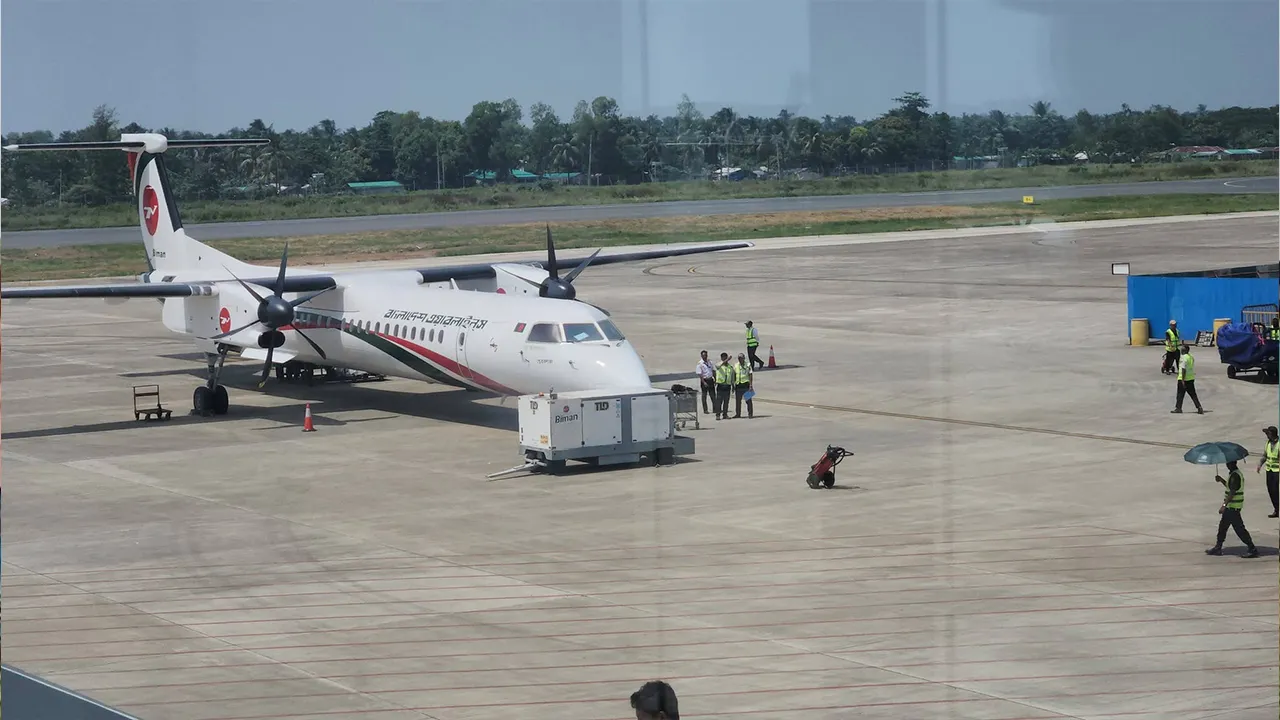
Cox’s Bazar Airport began trial operations at its newly built international terminal on Monday, with domestic flights operating from the new facility for the first time.
The visually striking terminal, designed in the shape of a seashell, marks a major milestone in the airport’s modernization and internationalization project. Passengers expressed excitement after experiencing the new terminal’s modern facilities and improved arrangements on the first day.
Officials involved in the project said that, if everything goes as planned, the government is expected to formally inaugurate the international terminal in the third week of October. This would pave the way for direct international flights to and from Cox’s Bazar.
The development is expected by tourism stakeholders to create new opportunities for the tourism industry, the blue economy and the wider local economy.
According to authorities, a Novoair flight carrying 70 passengers departed for Dhaka at 8:45am. Five minutes later, flights operated by Air Astra and US-Bangla Airlines also took off.
The Tk1,868-crore project began on August 29, 2021. One of its main components is the extension of the runway toward the Bay of Bengal by 1,700 feet. As a result, the runway has been extended from 9,000 feet to 10,700 feet, making it longer than the runway at Hazrat Shahjalal International Airport in Dhaka.
Sohan Rahman, who travelled on the first flight to Dhaka with his wife Marzina Rahman, expressed his satisfaction with the new terminal.
“For professional reasons, my wife and I frequently travel abroad. From that experience, I can say that the architectural design of this new terminal, inspired by a seashell, and its facilities are truly world-class. The modern check-in and security screening arrangements were particularly impressive,” he said.
Dhaka-based tourist Farhana Chowdhury also praised the new facility.
“In the old terminal, there was severe crowding and we often had to wait a long time for baggage. Today, I was delighted to see the spacious environment and modern automatic baggage belt in the new building,” she said.
She added that having an international-standard environment immediately after arriving in Cox’s Bazar could significantly enhance the travel experience for tourists. However, she said maintaining the impressive infrastructure properly over the long term would be the biggest challenge.
Tourism stakeholders said the internationalization of Cox’s Bazar involves more than simply upgrading the airport. They said regular international flights could increase the number of foreign tourists, but other facilities would also need to be improved.
These include multilingual information services for international visitors, safe transportation, stronger tourism police capacity, clean beaches, modern waste management, quality food and accommodation, and transparent tourism services.
The seashell-shaped terminal has a departure lounge with seating capacity for 450 passengers. The 18,000-square-metre international-standard building has 14 check-in counters and 10 immigration desks.
The terminal also features boarding bridges, lifts, escalators, duty-free shops, two international baggage belts, and advanced CCTV and security screening systems. Four immigration desks have been installed in the departure zone and six in the arrival zone to facilitate international passenger movement.
A 36,300-square-metre apron has also been constructed, allowing two large wide-body Boeing 777 aircraft and three Dash 8 aircraft to be parked simultaneously.
Mohammad Nur Nabi, mechanical engineer of the Cox’s Bazar International Passenger Terminal project, said testing and commissioning of the terminal’s electrical substation and mechanical automation systems had been completed.
“We have successfully completed all testing and commissioning of the electrical substation and mechanical automation systems. The terminal has an advanced automatic baggage-handling system. After check-in at the counter, baggage will automatically move to the airside,” he said.
He described the terminal as an outstanding combination of architecture and engineering.
Abu Morshed Chowdhury Khoka, former president of the Cox’s Bazar Chamber of Commerce and Industry and a tourism business leader, said the international terminal and the country’s longest runway extending toward the sea could bring major changes to Cox’s Bazar’s tourism and economy.
He said direct international flights would not only increase the arrival of foreign tourists but could also create opportunities to export products such as dried fish and fresh vegetables from Cox’s Bazar directly to global markets, including the Middle East.
Mustakim, general manager of a five-star hotel in Cox’s Bazar, said the opening of an international airport would create new opportunities for the local hotel and hospitality industry.
“Many foreign tourists and corporate clients were previously reluctant to come because there was no direct air connectivity. Now, with this attractive terminal and the capacity to accommodate large aircraft such as the Boeing 777, international tourists will be able to travel directly to Cox’s Bazar,” he said.
He expressed hope that investment and bookings at international-standard chain hotels and resorts would increase significantly.
Gholam Mortuza Hasan, manager of Cox’s Bazar Airport, said the airport had begun trial operations with domestic flights with great enthusiasm.
“Under the supervision of the Civil Aviation Authority of Bangladesh, a total of 16 security and service agencies, including Ansar, the Bangladesh Air Force and APBn, are working together at the airport to ensure world-class services for passengers,” he said.
He added that the airport was fully prepared to begin regular international flight operations in October.