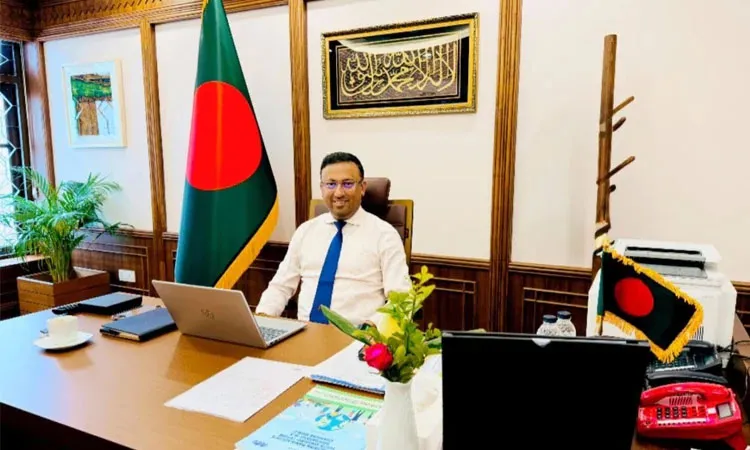
Prime Minister's Foreign Affairs Adviser Humaiun Kobir has said PM Tarique Rahman's visit to India could happen only once conditions of mutual trust, respect for sovereignty of diplomatic dialogue and a dignified invitation are met.
"There is no justification for rushing into a top-level visit by going beyond the national interest" Kobir told BSS in an interview at his Minto Road residence on August 17.
Despite Indian media speculation about a visit ahead of the BRICS Summit in New Delhi on September 12-13 Kobir said Bangladesh will not rush without clear national interest. "If an appropriate environment is created based on consensus between the two countries, Dhaka will express a positive attitude towards participation" he said, calling the visit reports "baseless and assumption-driven."
He said any future top-level visit depends on a shift in India's approach with adding that New Delhi "must properly understand the reality" of Bangladesh's July Mass Uprising, in which more than 1,500 people were killed. The possibility of a pre-BRICS visit "remains slim" without consensus and a dignified invitation he said.
Criticism over Hasina's presence in India
Kobir expressed strong resentment over convicted and fugitive individuals using Indian territory for political activity or media exposure also referring to former premier Sheikh Hasina, who fled to India after the uprising. He called it contrary to "India's democratic etiquette" and said such activity cannot be justified under international norms or freedom of expression. Bangladesh has lodged diplomatic protests with New Delhi and will continue pressing the issue, he said.

Balanced foreign policy and regional ties
Kobir said the government's "Bangladesh First" policy prioritizes national interest while remaining open to economic or defence cooperation with Saudi Arabia, Pakistan and Türkiye. PM Tarique Rahman's visit to Riyadh invited by Crown Prince Mohammed bin Salman, is expected to be finalized soon. Bangladesh is also strengthening trade and people-to-people ties with Pakistan.
Economic diplomacy with US, EU and China
Bangladesh is deepening commercial ties with the US and EU with talks progressing on soybean imports, Boeing aircraft purchases and a trade partnership agreement with the EU. Relations with China have reached "a new height" under a "Two Plus Two" mechanism with discussions ongoing to attract Chinese investment. The government is also focusing on strengthening ties with the UK diaspora to boost remittances.
African markets and Malaysia labour market
Kobir noted that 52 of 54 African countries backed Bangladesh's recent bid for the presidency of the UN General Assembly's 81st session. A high-level delegation including the foreign minister will soon visit Africa to pursue agreements on contract farming and new export markets. He also expressed optimism that stalled talks on reopening Malaysia's labour market for Bangladeshi workers would soon be resolved.
UN presidency and Rohingya crisis
Calling Bangladesh's UN General Assembly presidency victory a mark of global recognition for Tarique Rahman's leadership, Kobir said the government would use the platform to promote an ethical foreign policy while intensifying pressure on Myanmar toward a sustainable Rohingya solution. He said Bangladesh has built a strong foreign policy framework over the past 180 days also restoring the country's international standing.