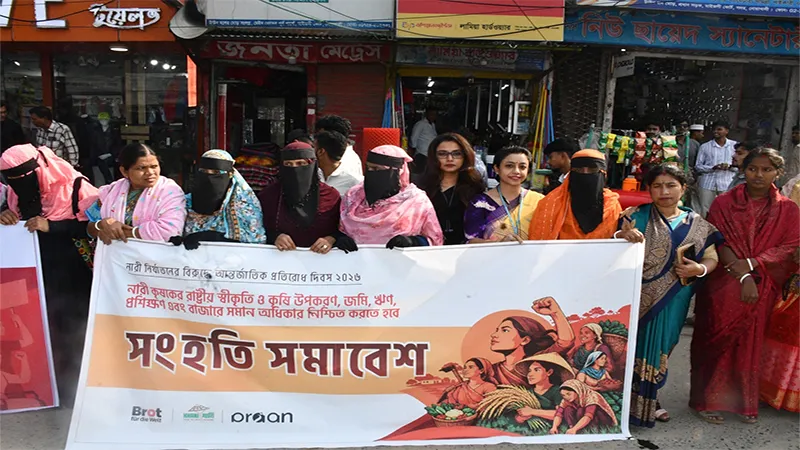
On the occasion of the International Day for the Elimination of Violence against Women, KHANI Bangladesh held a human chain and rally in Noakhali, demanding an end to violence against all women, including women farmers, state recognition of women farmers, and the establishment of their rights and dignity.
The gathering was organised on the morning of 25 November at the Noakhali Town Hall premises, led by the KHANI secretariat, Participatory Research & Action Network – PRAAN, with the participation of more than 35 organisations. As part of this gathering, KHANI Bangladesh organised a rally. Women farmers, farmers, youth, women’s rights activists, representatives of development partner organisations and journalists from different upazilas of Noakhali took part.
The International Day for the Elimination of Violence against Women marks the start of the 16 Days of Activism against Gender-Based Violence, which runs until Human Rights Day on 10 December. The United Nations has declared 2026 the International Year of the Woman Farmer. Against these two backdrops, the gathering highlighted the long-standing structural violence faced by women farmers. Nurul Alam Masud, Secretary of KHANI Bangladesh and Chief Executive of Participatory Research & Action Network – PRAAN, said that women carry out a large share of agricultural work, including sowing seeds, transplanting seedlings, harvesting, post-harvest processing, seed preservation, and rearing livestock and poultry. Yet the state has still not formally recognised them as farmers. As a result, they are deprived of government subsidies, agricultural loans, training, agricultural extension services and compensation during disasters. Women agricultural workers receive lower wages than men for the same work. Limited ownership of land and assets, along with climate disasters and displacement, is deepening this deprivation. Speakers said that this deprivation is long-standing political, social, economic and structural violence, which keeps women farmers dependent, undervalued and voiceless.
Floods, cyclones, crop losses, loss of livelihoods, food and water crises, and displacement increase the economic and social pressure on families, and the added household and care responsibilities placed on women further intensify the risk of violence. During disasters, women also face discrimination in access to safe shelter, food, water, health care and livelihood opportunities. Therefore, the prevention of violence against women must not be limited to social awareness or legal measures; it must be linked to the right to food, recognition of women’s labour, secure livelihoods, access to resources and climate justice, and legal and psychosocial support must be ensured for women who have survived violence.
From the gathering, demands for the rights of women farmers were raised around four pillars: safety and secure shelter, food security, livelihoods, and a dignified life. The demands include: state recognition of women as farmers and their inclusion in farmer registration and agricultural input assistance cards; equal access for women farmers to agricultural subsidies, loans, training, extension services and compensation during disasters; equal wages for women and men agricultural workers; women’s rights to land, water and productive resources; safe workplaces and communities free from violence, and access to justice for women who have survived violence; and the enactment of a Right to Food Act that recognises the role of women food producers.
At the end of the gathering, a rally titled ‘Protirodh Jatra’ (March of Resistance) was held from the Town Hall premises to the Noakhali Press Club premises. The rally expressed solidarity with all women who are victims of political, social, economic and structural violence, including women farmers.