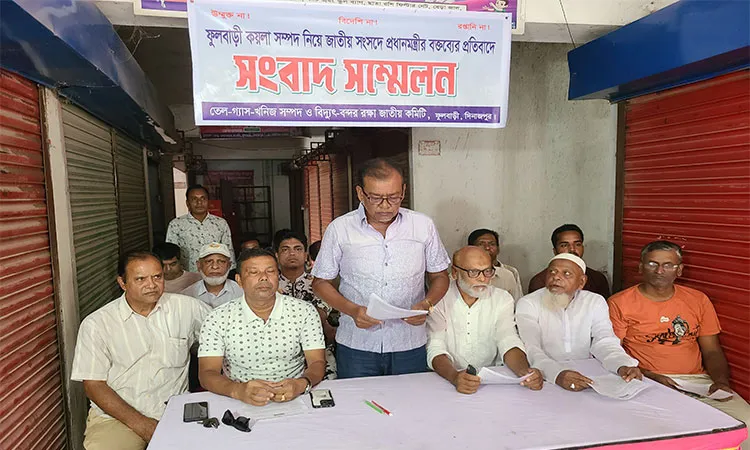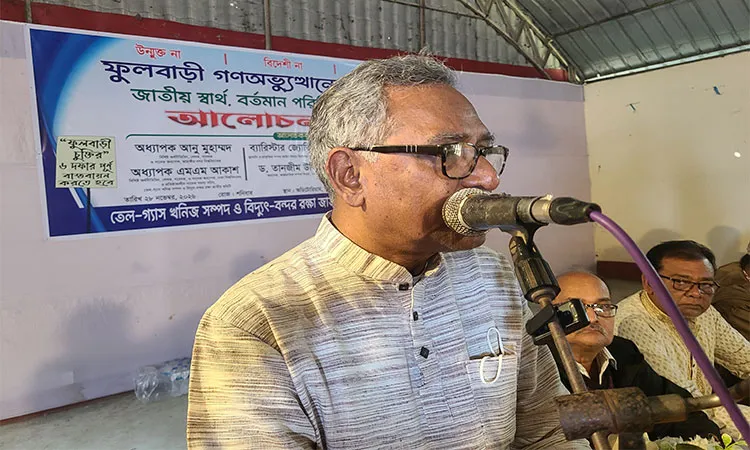
Professor Anu Muhammad has urged the government to fully implement the 2006 Phulbari six-point agreement and called on citizens to remain united against open-pit coal mining.
Speaking as chief guest at a discussion marking the 20th anniversary of the Phulbari uprising on Saturday, the Central Member-Secretary of the National Committee for the Protection of Oil, Gas, Mineral Resources, Power, and Ports said, "Some see only the coal in Phulbari while others see commissions—overlooking the people, environment and national interest."
The event, held at the Golam Mostafa Pilot High School auditorium in Phulbari, was presided over by local committee convener Syed Saiful Islam Jewel.
Anu Muhammad noted that successive governments left key clauses of the 2006 agreement unfulfilled, adding that strong public resistance prevented Asia Energy (now Global Coal Management) from entering the area even under Section 144 in 2012.
Dhaka University Professor MM Akash warned that GCM lacks the capacity for such a project and alleged plans to exploit Phulbari’s coal for foreign interests. Barrister Jyotirmoy Barua stressed that the state is legally bound to honour the remaining terms of the public agreement.
Highlighting economic and ecological risks, Dhaka University Professor Dr Tanzimuddin Khan argued that open-pit mining would devastate agriculture and drain foreign currency to foreign firms. Engineer Mahbub Suman pointed out that Phulbari coal-based electricity would cost around Tk.17 per unit, compared to Tk 4–5 for solar power. Professor Dr Maha Mirza added that one-time compensation cannot replace lost livelihoods or justify environmental destruction while Bangladesh seeks global climate funds.
The movement dates back to August 26, 2006 when three protesters Amin, Salekin and Tarikul were killed in law enforcement firing during demonstrations against Asia Energy, prompting the government to sign the six-point deal.