Bangladeshis now buy things in a very different way. There are more than half a million influencers in the digital creator economy. This is also affecting people's health after the pandemic. People are now more aware of their health. People are buying fewer mass-produced, chemically treated goods and more natural, useful goods. This shows that things are changing. This change is now a big part of the economy in many places, instead of just a small decision people have to make about how they live. This trend is bringing together the middle class in cities and the production in rural areas, which is good for small and medium-sized businesses (SMEs). As of late 2025, small and medium-sized businesses (SMEs) will account for 30% of the country's GDP and 85% of all jobs in the industrial sector.
Different types of organic goods
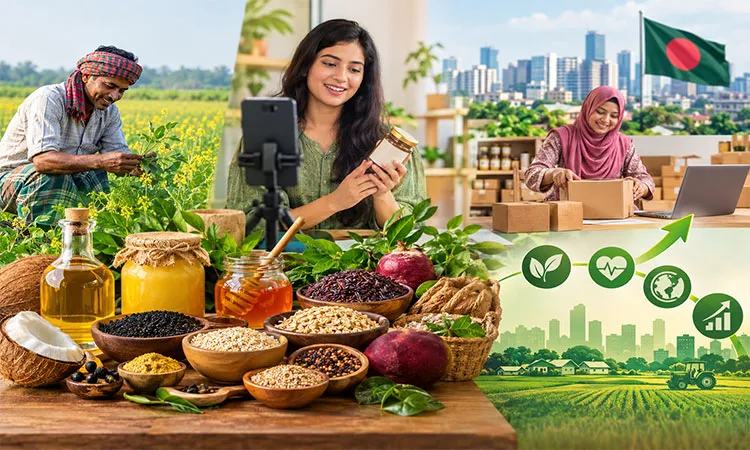
Bangladesh will have many different organic goods for sale by 2025. The market will be worth about BDT 4 billion, which is about $34 million. People are going back to using more traditional fats, like ghee and essential oils. Unrefined "Kachi Ghani" mustard oil accounts for $463 million in market value, representing 55.8% of the total. People also want a lot of extra-virgin coconut oil, black seed (kalo jeera) oil, and deshi ghee made from cows that eat grass.
It is becoming fashionable again to eat black rice and other grains that smell good. People with diabetes can also eat quinoa, steel-cut oats, and chia seeds. Similar to oats. People are starting to use coconut sugar and raw honey as natural sweeteners and healing powders, instead of refined sugars. Every year, the spice market grows by 6.3%. Herbal powders like Amla, Triphala, and Beetroot are known to keep cells from getting hurt. A lot of people want them.
How small and medium-sized businesses grow
Small and medium-sized enterprises (SMEs) are the primary drivers of this change in the environment. The Economic Census of 2024 found 11.8 million economic units, and an increasing number of them are making and selling natural health products. There are now 11.8 million SMEs, up from 7.8 million in 2013. A lot of people want to start their own businesses, as this shows. A lot of this is because women opened online stores during the pandemic.

Digital Integration: In 2025, beauty and personal care items made up 56% of all online sales. This lets small organic brands sell their goods directly to people in the city instead of through the usual channels. As the market grows, small businesses are becoming more specialized and less like typical stores. The 2025 Buyer-Seller Summit and other major events have shown how important these small- and medium-sized business groups are in areas such as herbal cosmetics and food processing. They believe that they are the most important part of the new green economy.
If you want to change, go back to the beginning
Bangladesh's farms are changing to grow more high-value crops because people want more organic products. In the fiscal year 2024–25, the total area of land used to grow oilseeds grew to 1.3 million hectares, and domestic production reached 1.7 million metric tons. Mustard farming, for example, has come back and grown 13 times in the last ten years. This is because it is a good crop that grows well and makes money between the Boro and Aman seasons. This change is not only making things last longer, but it's also making more of them.
Farmers who grow grains and spices without chemicals say their costs go down by 27% to 36% because they don't have to buy expensive chemicals. They can also charge 10% to 15% more for their goods in cities. There will be many effects on the economy. The rise of natural health products is affecting many important parts of the economy:
Import substitution
Bangladesh has always gotten about 85% of its cooking oil from other countries. More and more people are buying mustard, rice bran, and coconut oils that are made in their own countries. This is a very important step in the right direction for the economy. By 2027, the government wants to cut imports of edible oils by more than 40%. They want to do this by making more things at home to meet the need for healthier choices.
Health and Labor Productivity
The country is working to eliminate non-contagious diseases by moving toward safer food that doesn't contain pesticides or other chemicals that could harm people. In the long run, this will save you money. People can get better by eating black seed oil and raw honey. This means you won't have to take as many days off work, and you won't have to spend as much on health care.
Diversifying Exports
The market for agro-processed exports is worth about $1.1 billion and is growing by 16.6% annually. By 2026, the global organic market is expected to be worth $364 billion. Bangladesh aims to export $3 billion worth of agricultural goods by 2030. Small and medium-sized businesses (SMEs) can help the country reach this goal.
Problems with the Strategy
There is still a big trust gap in the industry, even though things are going well. Only 12% of agro-processing companies meet the requirements for international safety certification at this time. There isn't a cheap, standardized national organic certification system, which makes things hard for small business owners. There are still some holes in the infrastructure.
Author: Dr. Zobayer Ahmed is an Associate Professor at the Bangladesh Institute of Governance and Management (BIGM) and Dr. Anwar Hossain Chowdhury is an Assistant Professor at the Bangladesh Institute of Governance and Management (BIGM).